
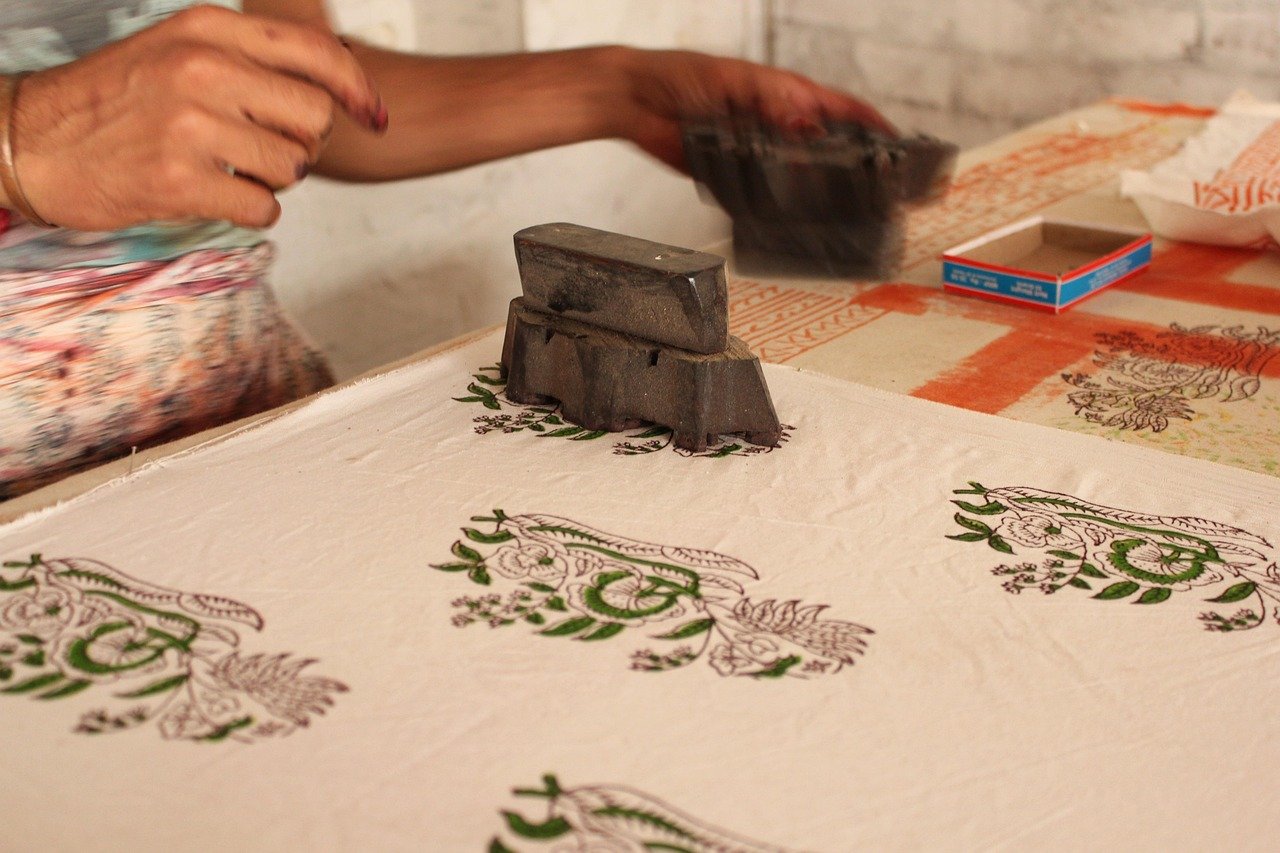
If you walk through the lanes of Bagru on a warm Rajasthani morning, you will notice something unusual — art doesn’t hang on walls here, it lies drying on the ground. Long rolls of cotton stretch across sand-covered courtyards, soaking in the desert sun just as they have for centuries.
Somewhere nearby, you’ll hear it —
the soft, steady sound of wood meeting fabric.
The rhythm of hand-block printing.
Follow the sound and you’ll find the Chhipa community — printers and dyers who have been practicing this craft for generations. They are not creating products. They are continuing a tradition that has lived for more than five hundred years.
The Block: Where the Story Begins
Every print begins with a block carved from sheesham or teak wood. One artisan may spend several days carving a single block, chiseling every line and curve by hand.
One block is used for one colour.
A multicolour design may require several blocks, each pressed with perfect alignment.
Some blocks are so old they carry the touch of four generations of printers.
The Colours: Developed From Nature
Rajasthan’s block printers do not rely on artificial inks. Their colours come from plants, minerals, and earth-based ingredients: indigo for blue, madder root for red, pomegranate rind for yellow, iron rust for black, and harda fruit for a natural base tone. These recipes are not written in books — they are inherited, memorized, and guarded with pride.
Regional Styles and Their Identity
Bagru
Known for rustic, bold patterns and the traditional mud-resist technique called dabu. Colours are earthy and natural.
Sanganer
Famous for fine floral motifs and white-base printing. The designs are delicate, Mughal-inspired, and detailed.
Barmer
Rich in folk motifs, often geometric and star-patterned, with deeper use of colour.
Akola
One of the lesser-known styles, known for indigo-based Nandana prints.
Each region prints not just patterns, but personality: Bagru feels like the desert, Sanganer like a royal garden.
The Process: Slow, Hands-On, Unrushed
The journey of a single cloth piece may include:
• washing and removing starch
• soaking in harda solution
• applying dye or mud resist
• hand-stamping with carved blocks
• drying under the open sky
• washing again for softness and colour-fastness
A single length of fabric may pass through ten to twenty pairs of hands before it is complete.
Why This Craft Still Matters
Hand-block printing is slow, imperfect, and completely human — and that is why it continues to matter in a world of industrial speed. A machine can print hundreds of metres in minutes. A block printer may print a few metres in a day. But the machine will produce uniform repetition. The artisan will produce character, variation, and life.
Block printing is sustainable by nature, not by trend. It uses less water, fewer chemicals, and relies on sunlight instead of electricity. It is also the livelihood of thousands of artisan families across Rajasthan.
When Block Print Enters Your Home
That cushion cover on your sofa, that quilt on your bed, that wall hanging on your accent wall — these pieces were not made in a factory. They were washed in river water, dried in desert wind, and printed by hand in a courtyard where skill is inherited, not taught in schools.
You are not just buying decor.
You are carrying forward a craft that refuses to disappear.
Hand-printed. Sun-dried. Story-carried. Rajasthan-made.
That is the soul of Indian hand-block printing.