
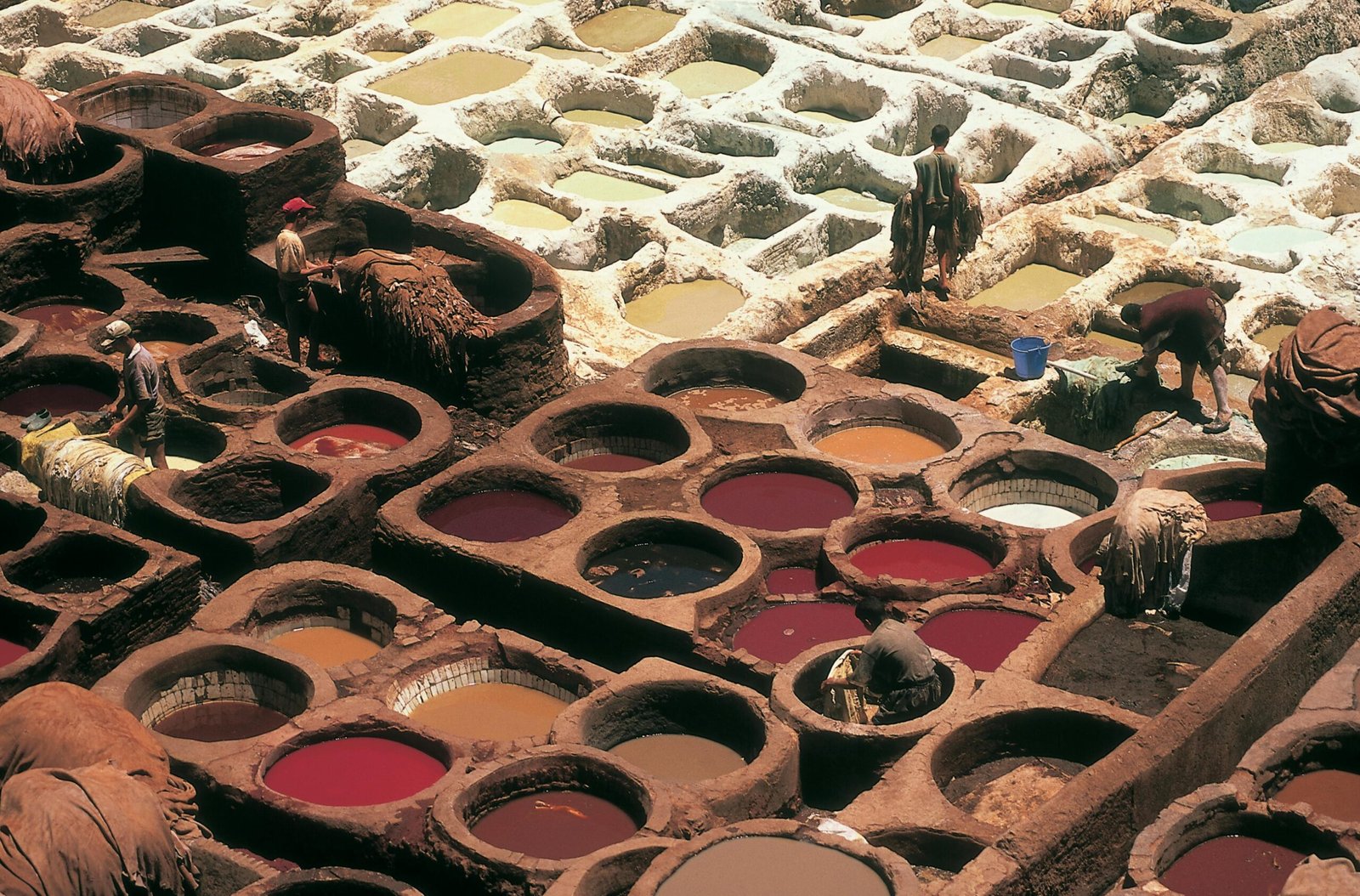
When I first stepped into the print-yard at dawn, the air smelled of wet clay and a faint, earthy sweetness—part soil, part plant. Long wooden blocks lay in neat rows, their carved faces ink-dark from centuries of rubbing. Around them moved artisans whose hands remembered rhythms their eyes could no longer describe: dip, stamp, press, lift. The colours on the cloth did not arrive as paint from a tube; they were coaxed out of roots, leaves and fruit skins—an old, slow chemistry that turned ordinary water and fabric into something that could stop you mid-step.
Indigo: India’s blue that travelled the world
The most famous of these colours is indigo—the deep, living blue that people once called “India’s blue gold.” The dye is extracted from Indigofera plants and has been used in the Indian subcontinent for millennia; archaeologists have found indigo-dyed cloth dating back to the Indus Valley civilisation. Traditionally, indigo does not dissolve in water: artisans ferment the leaves to reduce the dye to a soluble form, work the vat carefully, then dip cloth repeatedly to build up the deep blue that, when exposed to air, blossoms back into its characteristic indigo shade. Indigo’s journey from village vats to global trade routes altered economies and histories; it was precious enough to be fought over during colonial times.
Madder: roots that give a red heart
Not every red comes from an exotic insect. Madder—derived from roots of the Rubia species—has been a plant-source of reds for ages. In India, traces of madder-dyed textiles have been discovered in archaeological sites, establishing its ancient role in colouring cloth. Madder’s chemistry is rich: its roots contain compounds (notably alizarin and related anthraquinones) that bind to fibers when used with a mordant, producing reds that range from soft rose to strong crimson. Historically, complex processes such as the Turkey red method amplified madder’s brightness and wash-fastness for cotton, making madder-dyed chintzes highly sought after in international trade.
Pomegranate rind: a tannin-packed helper, and a yellow too
If you think a pomegranate only gives you ruby jewels to eat, think again. The rinds are rich in tannins—molecules that act much like a glue between dye and fiber. In many traditional dyeing systems, pomegranate rind is used both as a dye (producing soft yellows to yellow-greens) and as a mordant or tannin source that improves the light- and wash-fastness of other plant dyes. In several South Asian dyeing recipes, pomegranate is a trusted, locally available ally for making colours hold.
The invisible partner: mordants and the science of sticking colour
One of the things that surprised me standing in that old print-yard was how much of the “magic” is really chemistry. Natural dyes often need a mordant—a substance that fixes the dye to the fibre—so the colour survives washing, sunlight, and time. Common traditional mordants include alum (potassium aluminium sulfate) to brighten colours and iron or tannin-based baths to shift tones darker or greyer. These mordants are as essential to the process as the carved block; without them, many plant dyes just wash away.
More plants, more palettes
Beyond the famous trio, print-yards have a whole herbarium of hues: turmeric (haldi) for brilliant yellow, pomegranate and myrobalan (haṭha or haritaki) for tannin-rich foundations, kusumba or lac for specific regional shades, walnut hulls for deep brown, and weld (reseda) for lemon-yellows. Each region and cluster—Bagru, Sanganer, Kutch—carries its own palette and its own recipes, shaped by local plants, water, and the tastes of patrons.
Why these dyes still matter
There’s a romantic appeal to natural dyes—their stories, scent and the way they age into soft, soulful patinas—but there are also practical reasons artisans keep them. They’re part of cultural memory; they use regional botanicals; they support small-scale economies and craft knowledge passed down through families. Still, natural dyeing is not a simple environmental panacea: some processes need lots of water, and cultivating dye plants at scale requires land and care. So practitioners often pair traditional recipes with careful water management and small-batch production to keep the practice sustainable.
A block-printer’s morning (a small scene)
The printer I followed—an elderly woman named Meera—told me she learned to read the weather in the smell of her vats. “If the indigo sings,” she said, smiling, “you know the vat is ready.” She did not use written recipes. Instead, she measured by finger and feel: a handful of madder boiled until the scent turned sweet, a handful of leaves for a mordant, a pinch of ash here to lift a tone. Her apprentice sat nearby, carving the next block, listening for the rhythm that would make every repeat look like a breath: the same pattern, slightly different, alive.
If you want to try natural-dyed block prints at home (safely)
A note of caution: natural dyeing is delightful but technical. If you want to experiment, start small, use trusted sources or workshops, and respect safety—some mordants (and concentrated tannin baths) require careful handling. Look for workshops run by established craft clusters or studios that publish their methods transparently.
Sources and further reading
- Archaeological and historical context for indigo and its traditional production. [https://www.dsource.in/sites/default/files/course/artifact-temporal-and-spatial-mapping-visualization/case-studies/indigo/file/Indigo.pdf]
- Madder (Rubia) history, chemistry, and use in textile dyeing. [https://www.sciencedirect.com/science/article/pii/S1572599502800163]
- Pomegranate rind as a tannin source and natural dye — properties and traditional uses. [https://asianpubs.org/index.php/ajchem/article/download/17323/17276]
- Discussion of sustainability considerations for natural dyes vs synthetic dyes. [https://www.theguardian.com/sustainable-business/sustainable-fashion-blog/2015/mar/31/natural-dyes-v-synthetic-which-is-more-sustainable?]